CCLee Server Sentinel
One server, one monitoring plan: either we keep watch for you end to end, or we hand a proven monitoring system over to you.
What is CCLee Server Sentinel
CCLee Server Sentinel is a monitoring and alerting service for Linux servers, covering four types of monitoring: performance, availability, security (including signs of intrusion) and backup. It is activated per server: one server corresponds to one verification pass, and what gets verified is decided by the services running on that machine.
Choose either of two service models: Fully-managed — you do nothing; when something goes wrong, we handle it and tell you the outcome. Self-serve — alerts go straight to you, and you take action yourself.
Beyond cloud-vendor monitoring and panel tools, what's still missing
Your server runs websites, APIs and backend applications, and the existing tooling is not sparse: cloud-vendor monitoring gives you CPU, memory and disk curves; hosting panel tools give you service status and security logs; Uptime-style tools watch whether your homepage loads. But most of them stop at "giving you data" — several things remain that nobody does for you:
- Broken inside, invisible from the page. The page loads, the process is running, but the backend can no longer reach the database and payments keep failing — homepage-level probes can't catch this kind of critical error. It usually surfaces only when customers complain or the books don't reconcile.
- Piles of security logs, no sense of severity. Hundreds of brute-force attempts a day, the vast majority routine scanning — but among them may be a successful login from an unfamiliar IP. The tool records it; it won't judge which entry matters for you.
- Intrusions have no symptoms. Crypto-mining, tampered website files, sneaky cron jobs or unknown accounts are often discovered only when the machine gets sluggish or pages misbehave — and paid security add-ons are not cheap.
- A backup existing is not a backup working. Backup files keep being generated, but when disaster strikes and you actually need a restore, you discover they won't open or won't restore. Most people never verify; it surfaces only after data is lost.
- The monitoring system itself can go down. If monitoring dies and alerts go silent, who watches the watcher?
CCLee Server Sentinel fills exactly these gaps: it verifies "is this machine healthy, which issues actually matter, can backups really be restored", and when something happens, both the handling process and the outcome are clearly accounted for.
Two service models: the quick comparison first, details below
| Fully-managed | Self-serve | |
|---|---|---|
| What you do | Zero action after signing | Handle alerts yourself after activation |
| Who fixes problems | We do, and report the outcome to you | You handle them yourself |
| What you receive | Conclusions and resolutions | Event alerts, weekly checks, monthly reports |
| Best for | You who don't want to touch servers and have no technical team | You who have some technical skill but don't want to build monitoring from scratch |
Both models share the same monitoring engine, activated per server — not two disjointed products; the same server can start self-serve and switch to fully-managed later. Details below.
Fully-managed: you don't lift a finger, we do the work
What you do: sign the agreement and complete one onboarding authorization. After that, zero action — monitoring onboarding, daily watch and incident handling all happen without you.
What we do: monitoring runs 24×7 continuously (a collection round every 5 minutes, with independent public-network probes for verification). When something abnormal shows up, we verify it first, then set its severity; issues that need handling are handled by us until recovery, and then we tell you what happened, how it was handled, and the current status. What you receive is not a pile of alert emails — it's a conclusion.
Who is accountable: on the fully-managed track, accountability is ours — there is no gray zone of "the tool raised an alert, but nobody owned the fix". Response is tiered by urgency: critical issues trigger immediate handling, and response targets for each tier are written line by line in the service agreement at signing — in black and white, not verbal promises.
Why you can rest easy:
- You're notified only about persistent anomalies; one-off blips won't bother you;
- A newly onboarded server spends its first 48 hours in observe-only mode — we learn this machine's normal temperament before formal alerting begins;
- The monitoring system itself is watched by two independent mechanisms, so "monitoring died and nobody noticed" can't happen;
- Backups are really restored once a month for you to see — not just "the backup file exists".
Self-serve: a ready-made monitoring system you can use today
If you don't want to build monitoring from scratch but are willing to handle alerts yourself, choose self-serve: the monitoring items, alerting and reporting system are all ready-made, and alerts reach you directly after activation. Here is exactly what gets monitored on your server, type by type:
Performance: resource levels continuously visible
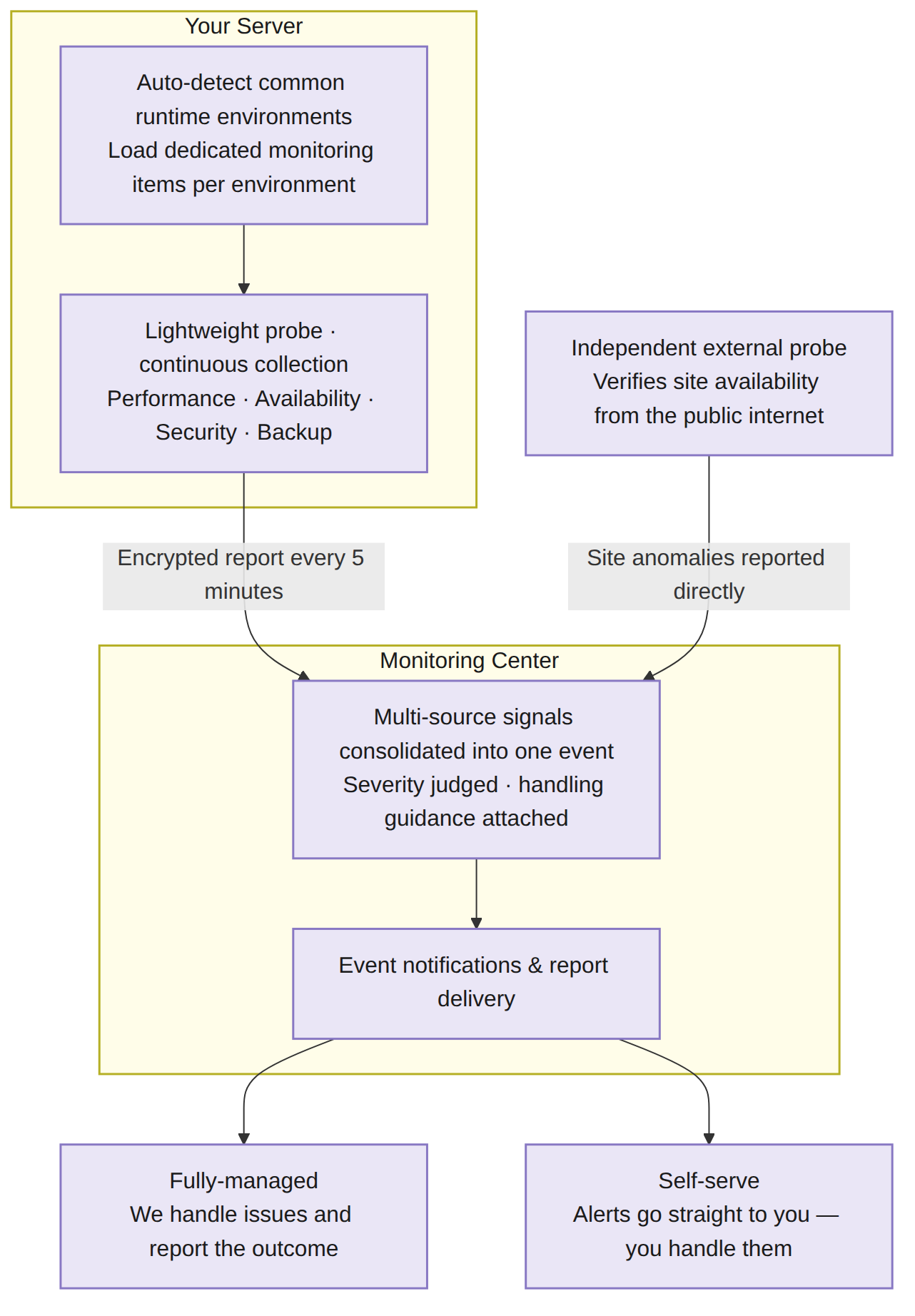
CPU, memory, disk and load are collected in rounds every 5 minutes; alerts fire only after metrics exceed thresholds across consecutive rounds — occasional transient spikes won't bother you.
Availability: verified from both the machine itself and the public internet
A live machine doesn't mean a working service. Local self-probes confirm the service process is responding, and independent external probes verify again from the public internet's perspective (for services with a public entry point); availability counts only when both directions pass.
Security: picking the real signal out of log noise
Firewall status, brute-force attempts, login records, certificate expiry and security updates are checked continuously. Signals like a successful login from an unfamiliar IP or a sharp spike in blocked attempts are graded individually — surfacing what genuinely needs attention instead of dumping raw logs on you. Critical application errors are also tracked continuously with error-window counting (how many times critical errors occurred within a time window).
Signs of intrusion: catching it before symptoms appear
Mining processes, changes to the baseline of cron jobs and startup items (what this machine's normal state looks like), accounts added outside the baseline — anomalies are detected by baseline comparison, with handling recommendations attached.
Backup: not just "is there a backup", but "can it be restored"
Daily backup status checks, cross-checked against the object-storage bucket (where backup files live in the cloud); a real restore drill once a month — the database is restored and verified table by table with row counts, proving backup restorability with measured numbers.
Automatic environment adaptation: the product's edge lies in "a universal monitoring engine + on-demand adaptation". One engine covers all kinds of Linux servers; common runtime environments are auto-detected and their dedicated monitoring items loaded immediately — no need to tell us what to watch. Unadapted environments fall back to the universal monitoring items, and special workloads can be customized on demand.
Both tracks run on the same operational pipeline:
What an alert looks like: conclusions, not data dumps
Dozens of raw alerts overnight, leaving you to find the correlations yourself. CCLee Server Sentinel consolidates same-period signals from multiple sources (availability, critical errors, security, backup) into a single event, judges its severity against the business this server carries, and attaches handling guidance — what the problem is, how urgent it is, what to do next. Items requiring action are notified immediately; informational content goes into the weekly check report.
For teams without dedicated ops staff, this turns alerts from "indecipherable — either information overload or simply ignored" into "readable, with a clear next step".
Customer story: a real fully-managed onboarding and backup verification
The client is a globally operating, industry-leading manufacturer whose products and services are used in landmark projects around the world.
Their business site runs on the fully-managed model — zero action after signing; monitoring onboarding and verification were completed by us; the first real restore drill was completed after the backup chain went live; weekly check reports and monthly reports have arrived on schedule ever since.
There is also a more complete hands-on case: An industry-leading manufacturer: post-intrusion rebuild and fully managed hosting.
Want to know the actual state of your server right now?
We offer a server assessment report valued at $399 (currently free): we examine running logs, resource levels, security signals and backup status, then deliver a diagnostic report telling you what needs attention and what monitoring would close. Read the report first, then decide whether to talk further.
Get Your Free Server Assessment